John Eichberger |
December 2025
It seems the years flow by much more quickly these days – maybe it is due to the speed of technology or maybe it is just because a year no longer represents as large a share of my life as it used to! Either way, December came upon us in a real hurry and it got me thinking about what has happened in the transportation sector this year and what it means.
First of all, I don’t want to spend time trying to list all of the developments this year – there are many articles and stories that cover these developments and I am certain I would miss many. Instead, I would prefer to contemplate the long-term implications of recent developments.
Back in May, the TEI Board of Advisors actually voted to initiate a review of the long-term implications of policy developments. Upon more careful consideration, however, we determined that there was no feasible way we could draft and publish a white paper that would not be woefully outdated by the time it was released. Instead, we decided to hold a series of webinars with experts on the topics to ensure the discussion was more timely and accurate. The first was held in September and addressed policies affecting the biofuels market; the second was in December and focused on the vehicle market. If you did not join us for these, I encourage you to check out the recordings.
I value these deep dives into key issues, but from a broader perspective their remains the question – where do we go from here?
Again, I am not trying to predict what will happen in government – I got out of that business a very long time ago. But we do convene with TEI members every quarter and explore what is happening in the market, how businesses are adjusting to changing dynamics and how policies may be affecting their strategic plans. What we have learned is quite different from what we read in the media – in short, most companies are not making drastic changes to their corporate business strategies.
Electrification
Of course, the news reports that automobile manufacturers are taking their foot off the accelerators on electrification with many significantly shifting investment strategies. While this may seem like a retreat from electric vehicles, that is not how we see it. Rather, we recognize that many of the early announcements and decisions to sprint towards an electric future were encouraged by policy leaders, by consulting firms advising investors, and the global drum beat that claimed transforming the transportation sector must happen “now.” If you look back through TEI articles, you will find that we never bought into that trend. History is quite clear that markets this size do not change overnight and, without a significant and immediately tangible boost in consumer value (economic and convenience), market transition will be choppy and slow.
What I see happening now, with domestic auto makers, is a balancing of priorities. Not all consumers are ready to transition to an electric vehicle. With policy changes, the manufacturers have been given some room to recalibrate their go-to-market strategies, to satisfy the needs of consumers and deliver vehicles that satisfy the needs of the market rather than focusing on aspirational objectives. Electric vehicles will continue to be a growth market because they are terrific vehicles, but instead of feeling like they don’t have much of a choice, consumers will be given options that appeal to their interests, pocket books, and needs. And in that context, I believe electric vehicle market share will continue to grow and be a sustainable portion of the overall market.
Carbon
It is no secret that the current administration is the polar opposite of the one it replaced, in almost every conceivable way. The federal government is no longer talking about climate change, carbon emissions reductions or other topics along these lines. In fact, they seem to be allergic to the topic. Does that mean support for carbon reductions has lost all momentum?
Living in the U.S., it would be very easy to assume that the climate agenda is over, but I believe that is a false conclusion. If we look around the developed world, we still see significant attention to climate change and carbon emissions reductions, but there is a different tone to the discussions, one that seems to recognize the needs of the people. Take Canada for example.
Our neighbors to the north have been much more progressive as a nation in their approach to address climate issues, having implemented a carbon fee system, adopting a zero emissions vehicle mandate, etc. The election earlier this year did not replace the party in power, but it brought into leadership a Prime Minister who had to face a very real situation – the Canadian economy could no longer be heavily reliant upon the United States. He immediately began charting a path forward in which Canada could strengthen its economy, become a global energy superpower and protect itself from the economic policies of other nations.
Has the Canadian liberal party abandoned its interest in fighting climate change? Absolutely not, but rather than sacrifice the economic sustainability of its people, the new policies recognize that protecting the environment requires a strong economy that can make the necessary investments to reduce emissions over the long term.
A similar reality struck the European Union when the natural gas pipelines coming from Russia were disrupted after the start of the Ukrainian war. The prospect of energy shortages and a potentially deadly winter forced leaders to shift focus to ensuring the economic and energy security of their people.
Does this mean that the environment is no longer important? No, but if the people are not cared for there will be no ability to invest in climate-friendly solutions.
Beyond government leaders, corporations have their own motivations and many multinationals have established environmental objectives of their own. These were developed for a wide variety of reasons, but there has been little indication that their commitment to achieving these objectives is in jeopardy. I would not be surprised to see many companies adjust the timing and intensity of their programs, but all conversations with TEI members over the past year have indicated little if any change to long term corporate strategic priorities.
Transportation
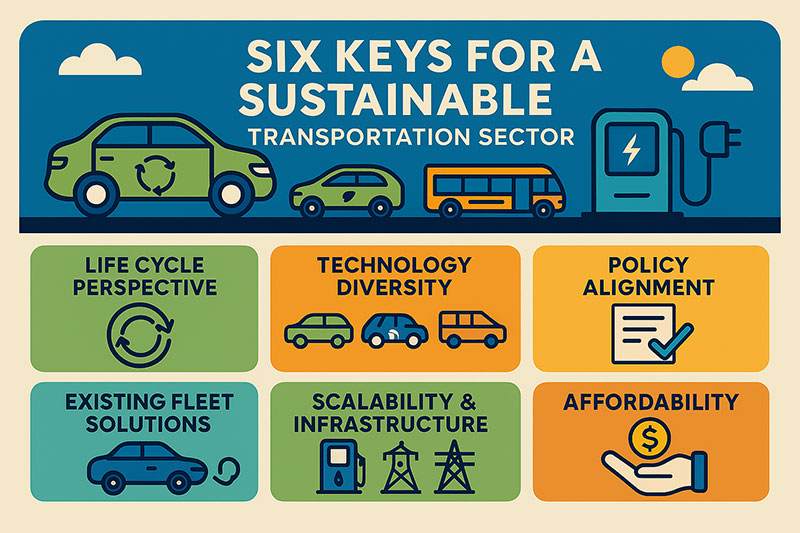
Both of the above sections have significant implications for the transportation sector. From TEI’s perspective, we really don’t see much change from how we have viewed the market the past several years. We have always noted that the 1.5 billion vehicles in operation in the world today will not be replaced immediately and that any strategy to reduce emissions must be viewed by the consumer as affordable and convenient. Nothing has changed.
Looking forward, the transportation market will continue to be a complex one characterized by dozens of vehicle types serving a wide variety of purposes. The vast majority of vehicles (light, medium and heavy duty) will continue to operate on gasoline and diesel fuel, including blends containing biofuels, with an increasing share in each class leveraging the power of electricity and perhaps renewable natural gas. I also hope that over the next decade or so we learn about new innovations that could help lead the market to a low cost and low emissions future.
More than a quarter of a century ago, I chose to enter the world of transportation energy because I wanted to be part of something that was important to the economy, the people and the country. I found the opportunity exciting because there were so many perspectives to consider, so many different paths the market could take and so many needs to satisfy. I am no less excited today as I was back then.
This past year has been one for the books but at the end of the day the fundamentals have not materially changed. People need to move themselves and things and how they prefer to do that varies greatly. Personal preferences, specific needs and economics influence decisions and a dynamic market with a wide variety of options will be able to satisfy these demands. We at TEI look forward to working with all of you as we explore how these options fit into the market and help achieve the various objectives we all might have.