John Eichberger |
July 2026
With the conflict in Iran disrupting global energy supplies, there has been renewed interest in the domestic, renewable biofuels sector. The higher volume obligations under the Renewable Fuel Standard (RFS), the clean fuel credits through 45z and potential congressional action to approve E15 for year-around sale have also spurred increased interest. However, there are some wrinkles that need to be explored, hence the new TEI publication, Mid-Level Ethanol Blends: Opportunities and Constraints in the Move Beyond E-15.
The fundamental issue that could drive consideration of moving beyond E15 is one based upon simple math. According to the U.S. Energy Information Administration (EIA) in its Annual Energy Outlook 2026, gasoline demand may drop from about 137 billion gallons per year in 2025 to around 76 billion in 2050 – a 45% reduction. This reduces the pool into which ethanol can be blended. In this scenario, if the ethanol industry were simply to stabilize at 15 billion gallons of ethanol each year, the decline in gasoline demand would require an increase in the average blend rate to nearly 19% in 2050. Consequently, even if every gallon were blended as E15 the market potential for ethanol would contract.
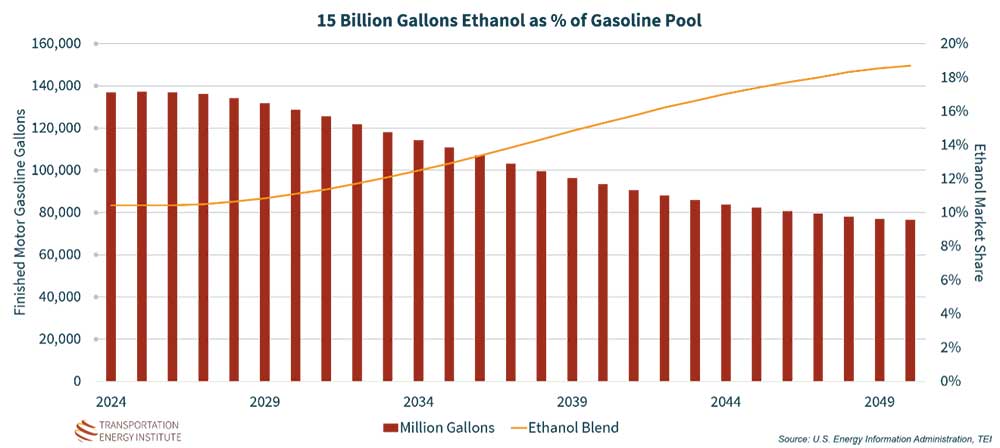
And despite the expectation that much of the increased RFS obligations are going to be satisfied with biomass-based diesel and the fact that significant investment is still pouring into the development of sustainable aviation fuel, the primary renewable fuel in the country remains ethanol, a fact that is unlikely to shift soon. Consequently, simply sustaining the ethanol industry at its current size will require nearly double the current average blend rate.
Our new paper is a peer-reviewed overview of the potential role of gasoline blended with between 16% and 50% ethanol. The paper is designed to establish a common understanding of the current definitions, standards, and regulations related to mid-level blends and to evaluate the opportunities and challenges associated with manufacturing, marketing, and consuming such fuels. It is not intended to resolve all questions about mid-level ethanol blends, but to prompt dialogue and discussion so stakeholders can better understand the issue.
Here is a high-level summary of some of this analysis – for more detailed evaluation of these issues, download the report for free.
Definitions & Regulatory Landscape
While a universal definition is still developing among major standards organizations (EPA, ASTM, UL, etc.), mid-level ethanol blends are generally recognized as E16 through E50, filling the regulatory gap between E15 and E85 (flex fuel). Transitioning to these blends requires harmonizing complex, overlapping regulations from the EPA, OSHA, NFPA, and ASTM covering emissions, engine safety, and retail equipment compatibility.
Core Market Perspectives: Opportunities vs. Challenges
- Environmental Impact –Ethanol’s carbon intensity (CI) is 44%–52% lower than gasoline (Argonne GREET model). Technical studies confirm reduced emissions of carbon monoxide, non-methanol hydrocarbons, and soot/particulates. However, research remains mixed regarding ethanol’s impact on nitrogen oxide (NOx) emissions.
- Energy Security – Increased ethanol adoption diversifies the national fuel supply. Crude oil and petroleum imports dropped significantly following the 2005 RFS. Others, however, note this import decline coincided directly with the U.S. shale oil boom, making it difficult to isolate ethanol’s contribution to overall energy independence.
- Octane, Engine Performance & Vehicle Compatibility – Ethanol boasts a higher Research Octane Number (~109 vs. 91–93 for conventional gas). In optimized engines, high octane boosts efficiency, power, and torque while preventing engine knock. However, most vehicles on the road are not optimized for high octane. Furthermore, non-flex fuel vehicles (FFVs) risk engine damage from mid-level blends. With FFVs representing only ~7% of the total vehicle fleet (20.2 million vehicles) and just six 2025 models offered, a viable vehicle market for blends does not yet exist.
- Misfueling Risks – Current safeguards for E15 and E85 rely primarily on pump labeling rather than physical nozzle barriers. Debates continue over whether warning labels are sufficient for mid-level blends or if mandatory physical prevention mechanisms are necessary.
- Fuel Pricing & Economic Realities –Blended fuels often lower consumer prices at the pump—especially during oil market spikes (e.g., E15 selling for up to $0.50/gal less than standard gas). However, true consumer value depends on the tradeoff between lower retail prices and reduced fuel energy density. For blenders and retailers, economic viability involves a complex balance of open-market commodity prices, energy equivalency, and RFS compliance credits (RIN values).
- Agricultural Economy – Ethanol production stimulates rural economies, creates jobs, and provides vital crop markets. Some question whether agricultural benefits should influence transportation fuel policies. The full report provides raw economic data on agriculture, food, and transport for independent evaluation.
- Retail Infrastructure & Availability -Storing and dispensing higher ethanol concentrations requires compatible infrastructure (underground tanks, pumps, hoses, and sealants). Because upgrading equipment is costly and consumer vehicle demand remains low, retailers face significant financial friction to adoption.
Conclusion
This paper presents an overview of the various arguments and challenges associated with mid-level ethanol blends, providing the reader with sufficient knowledge to engage in meaningful conversations about not only whether the market should consider moving beyond E15 but, if so, what would be required to successfully do so. There are significant challenges that must be overcome, many of which are technological or regulatory in nature while others reflect long-held assumptions or strongly divergent priorities within the transportation sector. The latter of these may be more difficult to resolve.
It is TEI’s intent that the new paper can serve as the basis for informed discussions about where the market can and might head in the future. Considering the robust peer-review to which this paper was subjected, TEI is confident the paper represents a balanced resource and reference for anyone engaged in this topic.